
Emergencies

Emergencies
Menu
  • About
      • About the VHC
      • Faculty and Staff Directory
      • Our Mission
      • Our Location
      • Contact Us
      • Academic Department
    • Close
  • Clients
      • Client Information
      • Make an Appointment
      • FAQs
      • Client Billing
      • Client Portal
      • Pay Your Bill Online
      • CareCredit
      • Pharmacy Services
      • Client Portal Instructions
      • Client Support
      • Client Satisfaction Survey
      • Touring the VHC
      • Our Location
      • Columbia Resources: Ways to Refresh While You Wait
      • Contact Us
    • Close
  • Small Animal

        • Hospital Overview


          573-882-7821
          After Hours: 573-882-4589
          Directions


          Contact Us

      • Anesthesiology
      • Cardiology
      • Community Practice
      • Dentistry
      • Emergency and Critical Care
      • Internal Medicine
      • Neurology/Neurosurgery
      • Oncology
      • Ophthalmology
      • Sports Medicine and Rehabilitation
      • Radiology
      • Reproduction (Theriogenology)
      • Shelter Medicine
      • Surgery
      • Canine Genetics Laboratory
      • Feline Genetics and Comparative Medicine Laboratory
    • Close
  • Equine

        • Hospital Overview


          573-882-3513
          After Hours: 573-882-4589
          Directions

          Contact Us

      • Ambulatory Service
      • Anesthesiology
      • Internal Medicine
      • Lameness Service
      • Wound Clinic
      • Ophthalmology
      • Radiology
      • Reproduction (Theriogenology)
      • Surgical Services
    • Close
  • Food Animal

        • Hospital Overview


          573-882-6857
          After Hours: 573-882-4589
          Directions

          Contact Us

      • Hospital Care
      • Ambulatory Services
      • Anesthesiology
      • Ophthalmology
      • Radiology
      • Reproduction (Theriogenology)
    • Close
  • Clinical Trials
  • Referrals
      • Referring Veterinarian Information
      • The Referral Process
      • VHC Referral Form
      • Overnight Transfers
      • Veterinary Diagnostic Laboratory
      • RDVM Portal
      • Referring Veterinarian Satisfaction Survey
      • Consultations
        • Cardiology Consultation Inquiry
        • Small Animal Internal Medicine Consultation Form
        • Orthopedic Referral and Estimate Inquiry
        • Neurology Referral Form
        • Nutrition Referral
    • Close
  • Giving
  • Employment
  • Internal
post

Simulations in veterinary medicine

By Alison LaCarrubba, DVM, DABVP
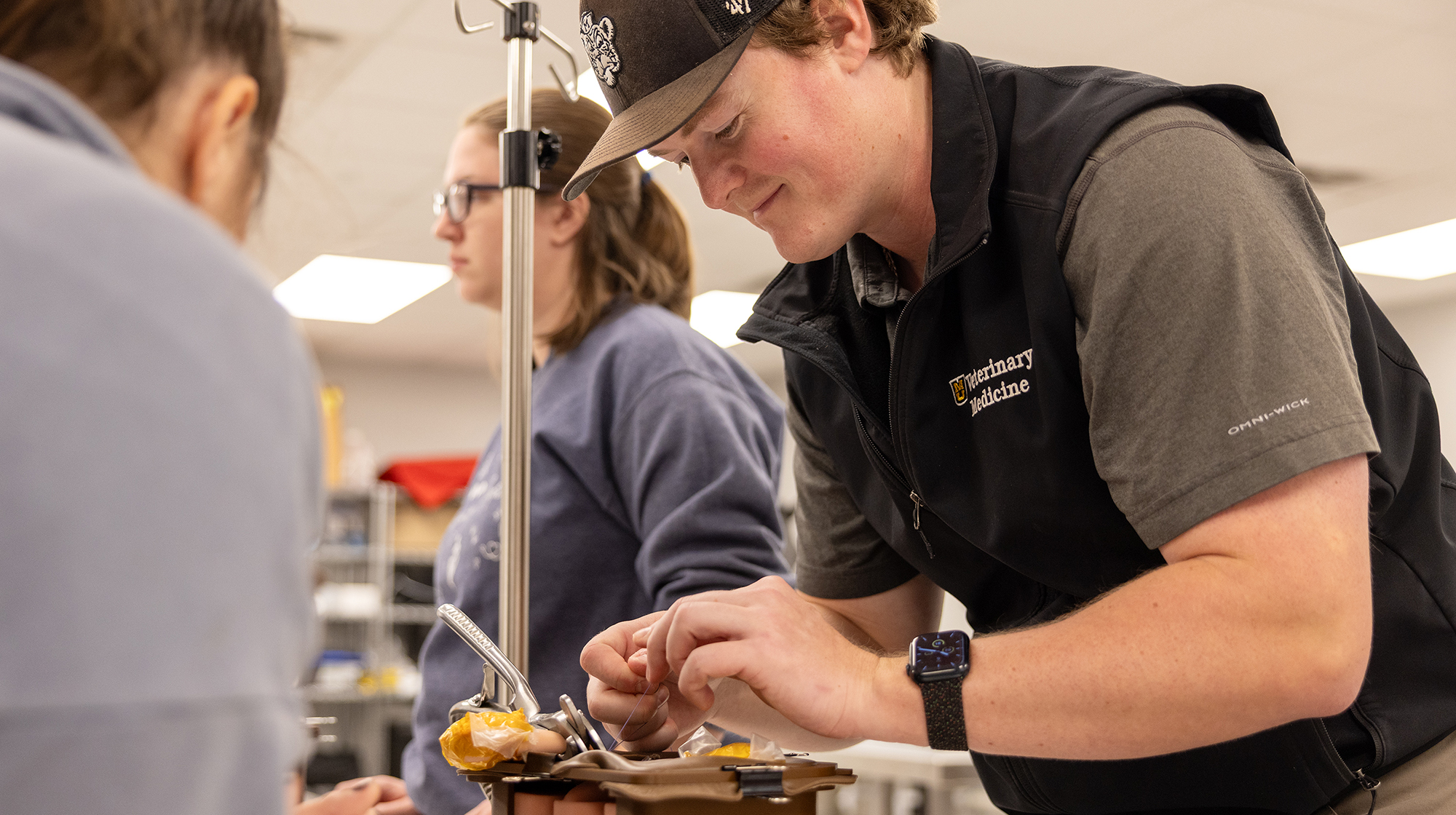
student in the clinical skills lab

The growth of our clinical skills program at Mizzou College of Veterinary Medicine is something we are very excited about. Innovations in teaching have encompassed models, simulations and communications training to enhance veterinary education. Veterinary medicine is a complex field requiring years of training, which includes not just book knowledge, but a variety of skills as well as communication training and business training.

What exactly is a simulation? Veterinary simulations can be life-like models used to practice procedures or experiences the students gain in practice sessions with actors or other veterinary students working through difficult client communications scenarios. The goal of simulations is to build technical skills as well as develop the communication skills required to be successful in practice. Veterinary simulation models allow veterinary students to gain experience without risk or stresses associated with working on live animals. Techniques such as learning a variety of suture patterns can be learned on “skin” made from silicone or other materials in a low stress environment. Studies have shown that when students learn new skills in a safe space such as a lab setting, these skills will later transfer to greater confidence and success in the clinic setting.

We have added a clinical skills program to our curriculum which allows students starting in their first year to practice and learn a variety of skills — from basic knot tying to physical examination skills and even palpation skills. Each instructional period a set of approximately five skills must be learned and evaluated using Objective Structured Clinical Examinations (OSCE), which are timed exams where the students must demonstrate each skill prior to moving on to the next instructional period. As the students progress through the curriculum, the skills become more complex. By the time our students reach their clinical rotations, they will feel comfortable performing a variety of technical skills as well as having practiced difficult communication scenarios. Furthermore, if students are having trouble while on a clinical rotation with a specific skill, they can return to the lab and practice this skill in a low stress environment until they are comfortable and capable. 

We are excited for what’s to come! We will be expanding our current lab and to introduce new technologies, such as virtual reality. Virtual reality is a computer-generated 3D environment that completely replaces the real-world allowing students to interact with a simulated setting using a headset and hand controls. This can be used to delve into anatomy or learn surgical procedures or even work through large animal on farm production scenarios.

We know that simulation won’t replace our anatomy lab dissections or client patient interactions, but we do know that by adding training modules from day one, our students will be better prepared for their clinical rotations creating a more positive environment for everyone involved — the students, clients and patients.

Contact

Small Animal Hospital
573-882-7821; After Hours: 573-882-4589
Regular hours: M-F, 8 a.m. to 5 p.m.
Emergencies: Please see current policies


Equine Hospital
573-882-3513; After Hours: 573-882-4589
Regular hours: M-F, 8 a.m. to 5 p.m.
Emergencies: Open 24 hours a day


Food Animal Hospital
573-882-6857; After Hours: 573-882-4589
Regular hours: M-F, 8 a.m. to 5 p.m.
Emergencies: Open 24 hours a day

Our Location

900 E. Campus Drive, Columbia, MO Veterinary Medical Teaching Hospital

Giving to the VHC

The MU Veterinary Health Center is a leader in animal disease diagnosis, patient care and education. Individuals and corporations from all over the world are making a difference every day by providing support for our facilities, programs, students and faculty.

Learn how you can help us continue provide the most cutting-edge, compassionate care.

© 2026 — Curators of the University of Missouri. All rights reserved. DMCA and other copyright information.
An equal opportunity/access/affirmative action/pro-disabled and veteran employer. Disability Resources