


Pamela Crawford of Washington, Missouri, doesn’t think her mastiff cross, Mr. Spock, resembles his “Star Trek” namesake at all in personality.
“He’s such a lover,” she said, adding that he has more of a surfer boy mentality. “He’s not like the character.”
Crawford found Mr. Spock, who is nearly 2 years old, at the Humane Society in Maryland Heights when he was a puppy. She had seen a listing for him online and went to meet him. When workers brought him into the room, she realized how he’d gotten his name. His left front paw was split, resembling the Vulcan salute the television character makes when saying “Live long and prosper.”
She quickly fell in love with his outgoing personality. Mr. Spock had been featured on a TV news segment promoting pet adoption, and the many visitors he received had made him comfortable around people.
“A lot of people had come to visit him, but they weren’t interested in adopting him; they just wanted to see his foot,” Crawford said. “He had been socialized quite a bit.”
Crawford adopted him right away.
Uncommon condition demands creativity
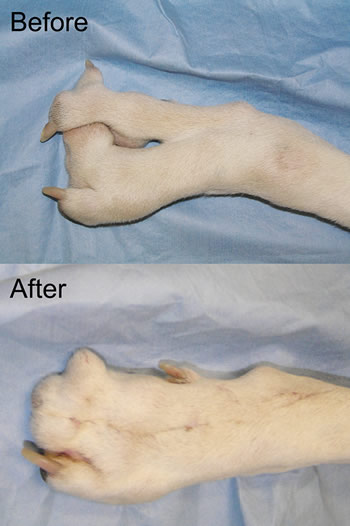
Mr. Spock’s ectrodactyly led to difficulty walking as he grew larger. After three surgeries and months of physical therapy, he can finally bear weight on his foot without pain.
Mr. Spock was born with ectrodactyly, a developmental abnormality. Often called split hand deformity when it occurs in people, the condition can cause a variety of problems.
In Mr. Spock’s case, he was missing one row of carpal bones, the bones that comprise the upper part of the foot in dogs and are comparable to the wrist in humans. His metacarpals, located below the carpal bones, were split between the second and third digits and fused between the third and fourth digits. He had extra nails, and some of them were curled under and protruding into the pads of his paw.
It initially caused few problems, but as he grew larger Mr. Spock had difficulty putting weight on his foot and couldn’t walk on hard surfaces.
“I noticed that the heavier and bigger he got, the more trouble he had with it,” Crawford said.
Crawford’s veterinarian referred her to the University of Missouri Veterinary Health Center to explore Mr. Spock’s treatment options.
The cause of ectrodactyly is unknown, and it seems to occur randomly, said Dr. James Tomlinson, a professor of veterinary orthopedic surgery at the MU College of Veterinary Medicine. Depending on the degree of deformity, the uncommon condition doesn’t always need to be addressed. However, Mr. Spock’s deformity was particularly severe. Like humans, he had begun walking plantigrade, meaning his entire foot touched the ground when he stepped.
Tomlinson said ectrodactyly cases can be complicated to fix because they’re not that common and because the exact problems vary among animals with the condition.
“The problem is that we don’t get to fix enough of them to really have a huge amount of experience as far as saying this is fixable,” he said. “These are difficult cases. Since no two are the same, it’s hard to just give an exact prediction of how well they’re going to do (with treatment).”
Because the pads of Mr. Spock’s foot were so deformed, efforts to reduce his walking problems would require a little bit of experimentation, Tomlinson said.
“The expectation is not for him to be 100 percent normal,” Tomlinson said. “His gait’s always going to be different. He’s probably going to favor the leg a little bit, but if we can make him pain-free and allow him to use his leg in a reasonable manner, that’s the goal.”
Crawford thought the goal was a worthy one, especially considering Mr. Spock’s reaction when he had the opportunity to play in the sand one day in her horse arena.
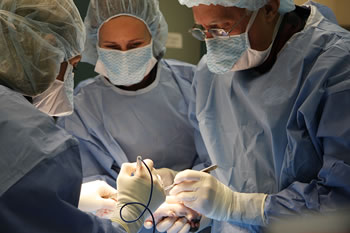
In Mr. Spock’s second surgery, veterinarians fused the wrist joint and closed the cleft between the bones in his foot.
“I took him down to the sand arena for the first time, and he actually could run,” she said. “And he ran and ran and ran and would not stop running. He was so happy. He was just going crazy. He ran until he collapsed.
“I just couldn’t take that away from him. It was such a happy moment.”
Series of surgeries leaves pup able to play
Tomlinson and other veterinarians at the VHC devised a plan that would address Mr. Spock’s deformity over a series of three surgeries. Spreading out the surgeries was important so he could heal and improve his strength through physical therapy between surgeries, Tomlinson said.
The first surgery involved amputating two of Mr. Spock’s P1s, or the bones located in the tip of the finger in humans. They were in an abnormal position that caused them to become frequently irritated, Tomlinson said. The goal was to reduce the irritation so Mr. Spock could be more comfortable.
Two months later, veterinarians performed the second surgery, a carpal fusion. During this surgery, Mr. Spock’s veterinarians implanted two bone plates with 20 screws to fuse the wrist joint and close the cleft between the bones in his foot.
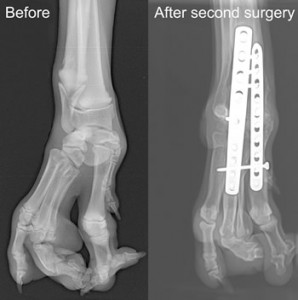
Radiographs show Mr. Spock’s foot before treatment and after his second surgery, in which veterinarians implanted two bone plates with 20 screws.
After the post-surgery swelling had subsided, he had to wear a cast for about two months while his foot healed. Then he began physical therapy on an underwater treadmill to build muscle and become used to walking on that foot. During the recovery period, he began using his leg while walking on grass and sand, but he still couldn’t use it on hard surfaces.
Finally, Mr. Spock was ready for his final surgery, called a podoplasty. The purpose of this soft-tissue surgery was to fuse the pads of Mr. Spock’s foot together. Although they normally wouldn’t be connected, this step was required because the bony formation on his foot was so abnormal and the pads were particularly separated, Tomlinson said. The goal was to make Mr. Spock more comfortable when stepping on his foot.
Following the podoplasty, Mr. Spock’s veterinary team waited for his foot to heal and then restarted his physical therapy.
After multiple surgeries and months of physical therapy, Mr. Spock now runs and plays nonstop without pain, Crawford said. She said he can bear weight on his foot and shows much more confidence on hard surfaces.
Both Tomlinson and Crawford consider the treatment efforts a success.
“My goal was for him to be pain-free and that the leg be functional,” Tomlinson said. “Now he can use it; he’s comfortable with it. From where we started to where we are today, I’m happy.”
Tomlinson isn’t the only one who is pleased.
“He’s running, he’s playing, he’s digging holes,” Crawford said about Mr. Spock. “He’s happy.”

He now enjoys running and playing without pain
